

Egypt’s foreign minister heads to Slovenia to boost relationship

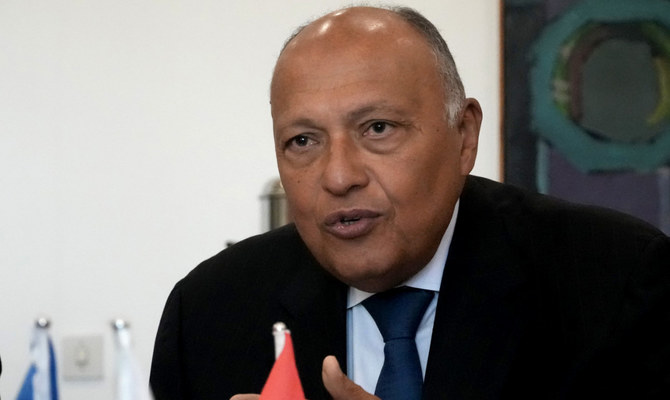
Egyptian Foreign Minister Sameh Shoukry. (AP)
Short Url
Updated 12 February 2024
Follow

Egypt’s foreign minister heads to Slovenia to boost relationship

  • The visit comes as part of the “qualitative shift witnessed in bilateral relations in recent years,” an official Egyptian statement said

CAIRO: Egyptian Foreign Minister Sameh Shoukry left for Slovenia on Sunday to lead his country’s delegation at a meeting of the two nations’ Joint Ministerial Committee for Economic Cooperation.

Ahmed Abu Zeid, spokesman for the ministry, said Shoukry would discuss with senior Slovenian officials various matters regarding bilateral relations and ways to enhance them.

Shoukry will also hold discussions with his Slovenian counterpart Tanja Fajon on a number of regional and international issues of common interest, most notably the Palestinian issue on which Slovenia has adopted supportive positions clearly demonstrated since the beginning of the Gaza crisis.

Shoukry will also meet Slovenian President Natasa Pirc Musar, Prime Minister Robert Golob, and Slovenia’s minister of economy and tourism, within the framework of coordination on ways to support and enhance bilateral cooperation.

The visit comes as part of the “qualitative shift witnessed in bilateral relations in recent years,” an official Egyptian statement said.

Slovenia’s president visited Egypt in December 2016 and the visit proved an important milestone in strengthening cooperation between the two countries.

Shoukry received a call from Fajon in June last year and the parties discussed economic and trade cooperation, and ways to develop it.

Slovenia and Egypt signed an agreement to establish diplomatic relations in 1992.


Trial opens in Tunisia of NGO workers accused of aiding migrants

Updated 59 min 7 sec ago
Follow

Trial opens in Tunisia of NGO workers accused of aiding migrants

  • Aid workers accused of assisting irregular migration to Tunisia went on trial on Monday, as Amnesty International criticized what it called “the relentless criminalization of civil society”

TUNIS: Aid workers accused of assisting irregular migration to Tunisia went on trial on Monday, as Amnesty International criticized what it called “the relentless criminalization of civil society” in the country.
Six staff members of the Tunisian branch of the France Terre d’Asile aid group, along with 17 municipal workers from the eastern city of Sousse, face charges of sheltering migrants and facilitating their “illegal entry and residence.”
If convicted, they face up to 10 years in prison.
Migration is a sensitive issue in Tunisia, a key transit point for tens of thousands of people seeking to reach Europe each year.
A former head of Terre d’Asile Tunisie, Sherifa Riahi, is among the accused and has been detained for more than 19 months, according to her lawyer Abdellah Ben Meftah.
He told AFP that the accused had carried out their work as part of a project approved by the state and in “direct coordination” with the government.
Amnesty denounced what it described as a “bogus criminal trial” and called on Tunisian authorities to drop the charges.
“They are being prosecuted simply for their legitimate work providing vital assistance and protection to refugees, asylum seekers and migrants in precarious situations,” Sara Hashash, Amnesty’s deputy MENA chief, said in the statement.
The defendants were arrested in May 2024 along with about a dozen humanitarian workers, including anti-racism pioneer Saadia Mosbah, whose trial is set to start later this month.
In February 2023, President Kais Saied said “hordes of illegal migrants,” many from sub-Saharan Africa, posed a demographic threat to the Arab-majority country.
His speech triggered a series of racially motivated attacks as thousands of sub-Saharan African migrants in Tunisia were pushed out of their homes and jobs.
Thousands were repatriated or attempted to cross the Mediterranean, while others were expelled to the desert borders with Algeria and Libya, where at least a hundred died that summer.
This came as the European Union boosted efforts to curb arrivals on its southern shores, including a 255-million-euro ($290-million) deal with Tunis.