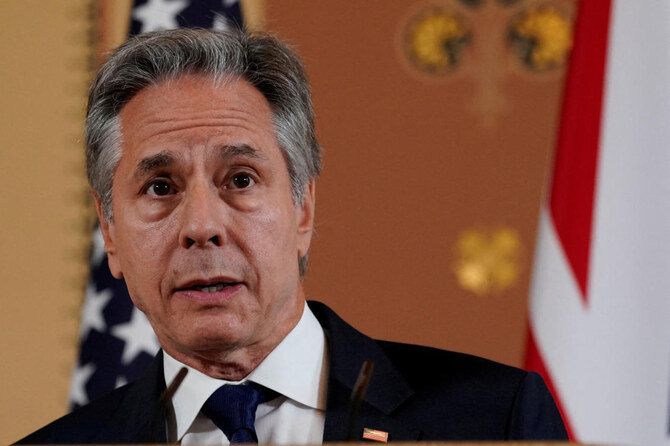
WASHINGTON: US Secretary of State Antony Blinken and his British counterpart David Lammy arrived in Kyiv on Wednesday for a series of meetings with senior government officials including Ukrainian President Volodymyr Zelenskiy.
Blinken and Lammy pulled into Kyiv's main train station ahead of a busy schedule that comes at a crucial time in the war, with Kyiv urging its allies to allow it to strike deeper into Russian territory with Western weapons.
"I think it’s a critical moment for Ukraine in the midst of what is an intense fall fighting season with Russia continuing to escalate its aggression," Blinken said in London at a news conference with Lammy on Tuesday.
“I think it’s a critical moment for Ukraine in the midst of what is an intense fall fighting season with Russia continuing to escalate its aggression,” Blinken said in London at a news conference with Lammy.
Zelensky has been pleading for Western countries to supply longer-range missiles and to lift restrictions on using them to hit targets such as military airfields inside Russia.
On the battlefield more than 2-1/2 years since the invasion, Ukrainian forces are being stretched by a better armed and more numerous foe, as they try to fend off creeping Russian gains in the east where Moscow is focusing its attacks.
In a bid to seize back some of the initiative and divert Russian forces, Kyiv sent troops into Russia on an audacious large-scale cross-border incursion last month, but Moscow’s troops have continued to inch forward in the east.
The visit also comes a day after Blinken in London said Russia has received ballistic missiles from Iran and will likely use them in Ukraine within weeks, warning that cooperation between Moscow and Tehran threatens wider European security.
The deepening military cooperation between Iran and Russia is a threat for all of Europe, Blinken said, and added that Washington had privately warned Iran that providing ballistic missiles to Russia would be “a dramatic escalation.” The US issued sanctions on Iran later on Tuesday over the transfer.
Blinken declined to say whether Washington will allow Ukraine to use long-range weapons deep inside Russia but said multiple factors went into the consideration of this decision rather than just looking at it as a weapons system.
“It’s not just the system itself that counts. You have to ask: Can the Ukrainians effectively use it, and sometimes that requires significant training, which we’ve done. Do they have the ability to maintain it?,” Blinken said.
Zelensky has long pushed back against allies who have supplied long-range weapons but told Kyiv they cannot use them deep inside Russia for fear of instigating a direct conflict between the West and Russia’s President Vladimir Putin.
Thousands of civilians have died in the war, which Russia started with a full-scale invasion on Ukraine in February 2022. Millions of Ukrainians have also been displaced, while their cities and villages have become piles of rubble.
Russia has escalated its drone and missile attacks on Ukraine in recent weeks, while Ukraine has also sent hundreds of long-range attack drones deep into Russian territory.
Later this month, Zelensky travels to the United States and will present a plan to President Joe Biden and his two potential successors in Novembers election that he hopes will bring the end of the war closer.


Blinken, Lammy arrive in Kyiv for talks with Ukraine’s leaders
https://arab.news/vj6h3
Blinken, Lammy arrive in Kyiv for talks with Ukraine’s leaders

- The top US diplomat, who is traveling to Ukraine alongside Britain’s Foreign Secretary David Lammy, said he will use his visit to hear directly from Ukrainian President Volodymyr Zelensky


Trump sues the BBC for defamation over editing of January 6 speech, seeks up to $10 billion in damages
- A BBC spokesperson told Reuters earlier on Monday that it had “no further contact from President Trump’s lawyers at this point
- The BBC is funded through a mandatory license fee on all TV viewers, which UK lawyers say could make any payout to Trump politically fraught
WASHING: President Donald Trump sued the BBC on Monday for defamation over edited clips of a speech that made it appear he directed supporters to storm the US Capitol, opening an international front in his fight against media coverage he deems untrue or unfair. Trump accused Britain’s publicly owned broadcaster of defaming him by splicing together parts of a January 6, 2021 speech, including one section where he told supporters to march on the Capitol and another where he said “fight like hell.” It omitted a section in which he called for peaceful protest.
Trump’s lawsuit alleges the BBC defamed him and violated a Florida law that bars deceptive and unfair trade practices. He is seeking $5 billion in damages for each of the lawsuit’s two counts. The BBC has apologized to Trump, admitted an error of judgment and acknowledged that the edit gave the mistaken impression that he had made a direct call for violent action. But it has said there is no legal basis to sue.
Trump, in his lawsuit filed Monday in Miami federal court, said the BBC despite its apology “has made no showing of actual remorse for its wrongdoing nor meaningful institutional changes to prevent future journalistic abuses.”
The BBC is funded through a mandatory license fee on all TV viewers, which UK lawyers say could make any payout to Trump politically fraught.
A spokesman for Trump’s legal team said in a statement the BBC “has a long pattern of deceiving its audience in coverage of President Trump, all in service of its own leftist political agenda.”
A BBC spokesperson told Reuters earlier on Monday that it had “no further contact from President Trump’s lawyers at this point. Our position remains the same.” The broadcaster did not immediately respond to a request for comment after the lawsuit was filed.
CRISIS LED TO RESIGNATIONS
Facing one of the biggest crises in its 103-year history, the BBC has said it has no plans to rebroadcast the documentary on any of its platforms.
The dispute over the clip, featured on the BBC’s “Panorama” documentary show shortly before the 2024 presidential election, sparked a public relations crisis for the broadcaster, leading to the resignations of its two most senior officials.
Trump’s lawyers say the BBC caused him overwhelming reputational and financial harm.
The documentary drew scrutiny after the leak of a BBC memo by an external standards adviser that raised concerns about how it was edited, part of a wider investigation of political bias at the publicly funded broadcaster.
The documentary was not broadcast in the United States.
Trump may have sued in the US because defamation claims in Britain must be brought within a year of publication, a window that has closed for the “Panorama” episode.
To overcome the US Constitution’s legal protections for free speech and the press, Trump will need to prove not only that the edit was false and defamatory but also that the BBC knowingly misled viewers or acted recklessly.
The broadcaster could argue that the documentary was substantially true and its editing decisions did not create a false impression, legal experts said. It could also claim the program did not damage Trump’s reputation.
Other media have settled with Trump, including CBS and ABC when Trump sued them following his comeback win in the November 2024 election.
Trump has filed lawsuits against the New York Times, the Wall Street Journal and a newspaper in Iowa, all three of which have denied wrongdoing. The attack on the US Capitol in January 2021 was aimed at blocking Congress from certifying Joe Biden’s presidential win over Trump in the 2020 US election.


