


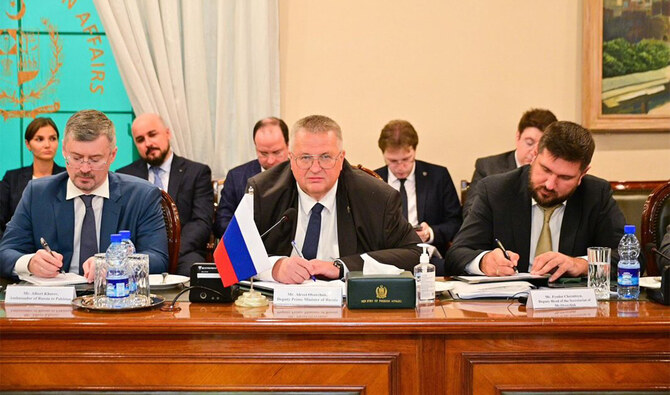
ISLAMABAD: Russia’s Deputy Prime Minister Alexey Overchuk said on Wednesday that Moscow would support Pakistan’s bid to join BRICS, an intergovernmental organization featuring the world’s leading emerging market economies.
Overchuk arrived in Islamabad on a two-day visit with a high-level delegation. He held talks with his counterpart Deputy Prime Minister Ishaq Dar after which both sides signed a memorandum of understanding (MoU) for bilateral cooperation relating to economy and trade.
In 2006, Brazil, Russia, India and China created the “Bric” group before South Africa joined in 2010, making it “Brics.” The bloc was founded as an informal club to provide a platform for its members to challenge a world order dominated by the United States and its Western allies.
Countries like Pakistan who want to join BRICS see it as an alternative to global bodies viewed as dominated by the traditional Western powers and hope membership will unlock benefits including development finance, and increased trade and investment. Pakistan had last year applied to become a member of BRICS.
“We are happy that Pakistan has applied [to BRICS],” Overchuk said during a joint press stakeout with Dar. “And, of course, BRICS and Shanghai Cooperation Organization are brotherly organizations, and we will be supportive of that.”
Dar held delegation-level talks with Overchuk where the two sides reviewed the entire spectrum of bilateral cooperation and agreed to pursue robust dialogue and cooperation in all areas.
Pakistan and Russia, once Cold War rivals, have warmed up to each other in recent years through regular business and trade interactions. As Islamabad seeks to enhance its role as a transit hub for landlocked economies in Central Asia, it has expressed interest in connecting with Russia through Central Asia for bilateral trade.
“We agreed today to identify specific projects in all areas of mutual interest on the bilateral agenda, including trade, economy, energy, connectivity, culture, educational relations and people-to-people contacts,” Dar said.
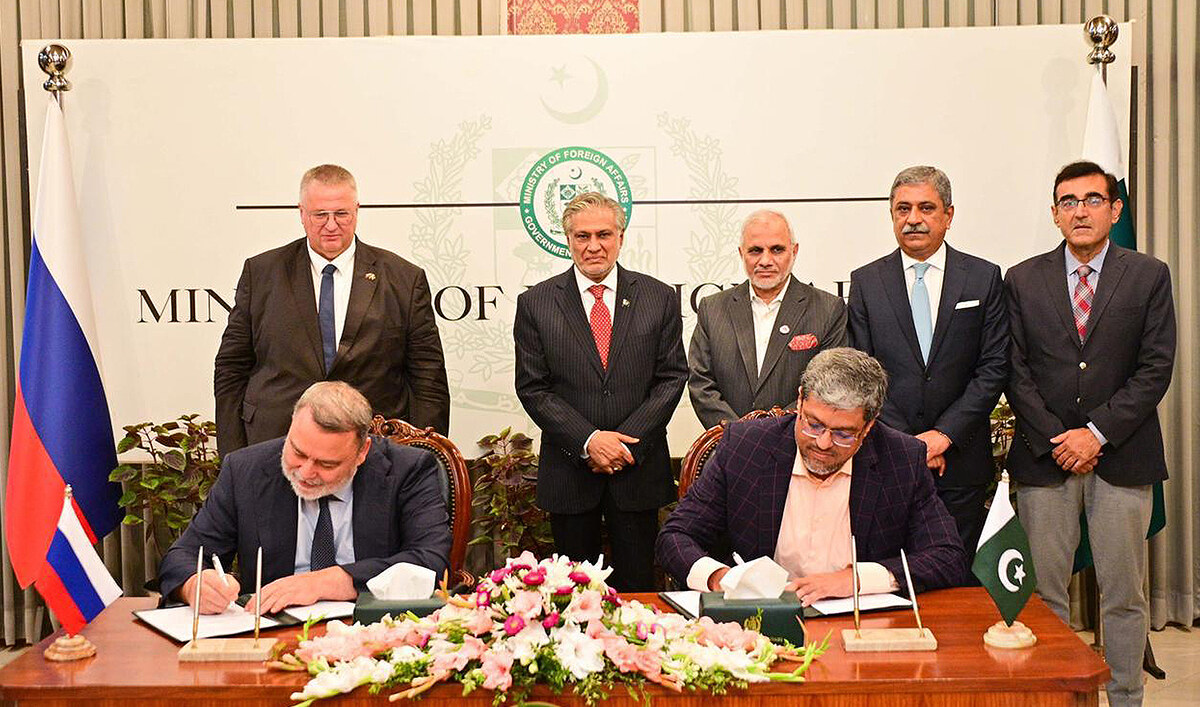
Russia’s Deputy Prime Minister Alexey Overchuk (first from left in the second row) and his Pakistani counterpart, Ishaq Dar (second from left in the second row), oversee the signing of a memorandum of understanding (MoU) between the two countries in Islamabad, Pakistan, on September 18, 2024. (PID)
He said bilateral trade between Pakistan and Russia last year reached an “unprecedented” $1 billion mark, adding that efforts were underway to further enhance it.
“There is the Pakistan-Russia Trade and Investment Forum, which is taking place of its unique nature first time from September 30 to October 1 in Moscow, and we are looking into all areas of mutual cooperation, be it trade, connectivity, the road, railways, energy, agriculture and even education,” Dar said.
The Pakistani deputy prime minister said preparations were being made for the ninth session of the Pakistan-Russia Commission on Trade, Economy, Science, Technology, Culture which is scheduled to be held in Russia by the end of this year.
Overchuk said Russia is interested in expanding regional ties with Pakistan, especially with an important Shanghai Cooperation Organization meeting set to take place in Islamabad next month.
“Prime Minister Mikhail Mishustin is expected to take part in this meeting,” he confirmed.
‘SIGNIFICANT VISIT’
Foreign affairs experts described the visit as a “significant” one considering Pakistan’s efforts to strengthen economic ties with Russia, the upcoming SCO summit and security challenges in Afghanistan.
“It is indeed a significant visit and a good thing that Pakistan is interacting with Russians as we have a very extensive agenda including trade, energy and economic challenges so we need to engage with them,” former Pakistani foreign secretary Salman Bashir told Arab News.
He said both sides would likely have discussed Afghanistan, as Pakistan is facing numerous challenges from the neighboring country, particularly those related to security.
Dr. Talat Shabbir, director of the China-Pakistan Study Center at the Institute of Strategic Studies, said the visit benefits both countries as Russia is seeking to strengthen regional alliances amid gloal pressure from the Ukraine war.
“Russia is facing a lot of criticism on Ukraine war especially from Europe and Russia obviously wants maximum friends and especially in the region, therefore the visit is beneficial for both countries,” Shabbir told Arab News.


