
Plastic pollution treaty not dead in the water: UN environment chief

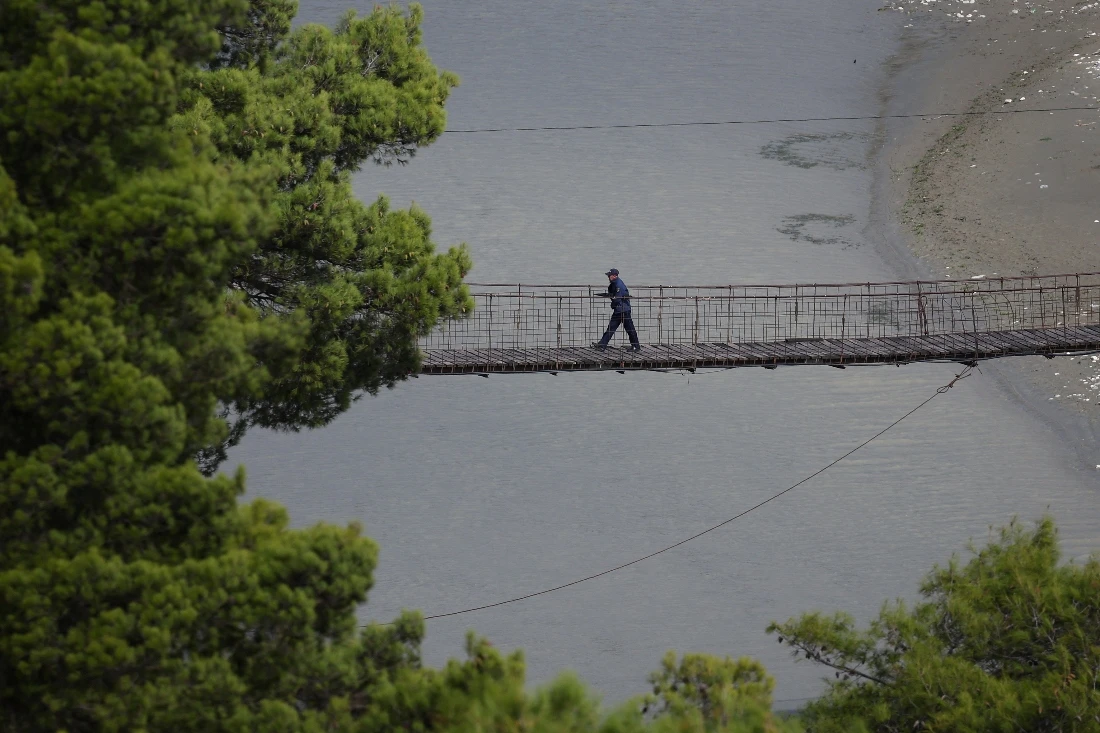
A man walks on a bridge by the Vjosa valley, recently designated a UNESCO site, in Tepelene, Albania. (Reuters)
Short Url
Updated 10 October 2025
Follow

Plastic pollution treaty not dead in the water: UN environment chief

  • The plastic pollution problem is so ubiquitous that microplastics have been found on the highest mountain peaks, in the deepest ocean trench and scattered throughout almost every part of the human body
  • More than 400 million tons of plastic are produced globally each year, half of which is for single-use items

GENEVA: The UN’s environment chief insists that a landmark global treaty tackling plastic pollution remains achievable, despite talks twice imploding without agreement, and the chair suddenly resigning this week.
United Nations Environment Programme (UNEP) executive director Inger Andersen told AFP in an exclusive interview that countries were not walking away, regardless of their sharp differences on combating the ever-growing problem, including in the oceans.
A large bloc wants bold action such as curbing plastic production, while a smaller clutch of oil-producing states wants to focus more narrowly on waste management.
Supposedly final talks in South Korea in 2024 ended without a deal — and a resumed effort in Geneva in August likewise collapsed.
Countries voiced anger and despair as the talks unraveled, but said they nonetheless wanted future negotiations.
“We left with greater clarity. And no-one has left the table,” said Andersen.
“No-one has walked away and said, ‘this is just too hopeless, we’re giving up’. No-one. And all of that, I take courage from.”

- ‘Totally doable’ -

The plastic pollution problem is so ubiquitous that microplastics have been found on the highest mountain peaks, in the deepest ocean trench and scattered throughout almost every part of the human body.
More than 400 million tons of plastic are produced globally each year, half of which is for single-use items.
While 15 percent of plastic waste is collected for recycling, only nine percent is actually recycled.
Nearly half, or 46 percent, ends up in landfills, while 17 percent is incinerated and 22 percent is mismanaged and becomes litter.
Annual production of fossil fuel-based plastics is set to triple by 2060.
As things stand, there is no timetable for when further talks might be held, and no countries have made formal offers to host them.
But Andersen “absolutely” thinks a deal is within reach.
“This is totally doable. We just need to keep at it,” she said.

- Red line clarity -

UNEP has been shepherding the talks process, which began in 2022.
Summarising where countries are at, Andersen said: “The mood music is: ‘we’re still in the negotiations. We are not walking away. We have our red lines, but we have a better understanding of the others’ red lines. And we still want this’.”
Andersen said Norway and Kenya convened a well-attended meeting at the UN General Assembly in New York last month.
The COP30 climate summit in Brazil in November will provide another opportunity to put the feelers out, ahead of the UN Environment Assembly in Nairobi in December.
Luis Vayas Valdivieso, Ecuador’s ambassador to Britain who chaired the last three of six negotiation rounds, has announced he is stepping down, leaving the process rudderless.

- ‘Serious allegation’ -

Vayas’s Geneva draft treaty text was instantly ripped apart by countries in brutal fashion, and while a revised effort gained some traction, the clock ran out.
British newspaper The Guardian reported that staff from Andersen’s UNEP team held a covert meeting on the last night in Geneva, aimed at coaxing members of civil society groups into pressuring Vayas to quit.
“This is a very, very serious allegation,” Andersen said.
“I did not know and obviously had not asked anyone to do something of this sort.”
She said the allegation had been referred to the UN’s Office of Internal Oversight Services.
“I’ve been in this business for 40 years, and I have never, ever done such a thing, and I would never have asked a staff of mine, or anyone else for that matter, to go and have covert meetings and quote my name and ask to undo a seated chair who is elected by member states. It’s outrageous.”
As for whether a new chair could provide fresh momentum, she said: “As always, when there’s change, there is a degree of a different mood.”


US hotels seek World Cup boost after tourism dip under Trump

Updated 58 min ago
Follow

US hotels seek World Cup boost after tourism dip under Trump

  • At the US hotels that Meade Atkeson manages, a drop in tourism weighs heavily on business — but hoteliers like him hope that World Cup enthusiasm will soon eclipse wariness over President

WASHINGTON: At the US hotels that Meade Atkeson manages, a drop in tourism weighs heavily on business — but hoteliers like him hope that World Cup enthusiasm will soon eclipse wariness over President Donald Trump’s policies.
The US hospitality sector has been reeling from a tourism slump in the world’s biggest economy, which became the only major destination to see a drop in foreign visitors last year.
“Just financially, it’s difficult when international travel is down,” Atkeson told AFP, noting that such visitors tend to stay longer and spend more.
Foreign travelers account for nearly a quarter of business at the three hotels under Sonesta group that he manages — two in Washington and a third in Miami Beach.
Yet, in the first eleven months of 2025, US official data showed that inbound travel dropped by 5.4 percent.
Canadians were noticeably absent, with travel plunging by 21.7 percent from 2024, translating to about four million fewer people. The decline was nearly seven percent for French visitors.
Industry professionals see this as a consequence of Trump’s policies, even if they may not openly say so.
Visitors have chafed at the Republican president’s sweeping tariffs on foreign goods, broadsides against other countries, tightening immigration rules and portrayal of certain Democrat-led cities as ridden with crime.
Canadians “were asked to be the 51st state, right?” Atkeson said.
“If you talk to Canadians, many of them have chosen not to travel out of conscience” or on principle, he added.
Brazilian tourists meanwhile “can go anywhere they want,” he said. “And so they may have gone to Europe, they may have gone to the islands.”
‘Fear’
Thousands of kilometers away, the major resort city of Las Vegas in Nevada — boasting 150,000 hotel rooms — has also had a bad year.
Elsa Rodan, a chambermaid at the Bellagio resort and casino, says her establishment is “blessed” compared with others.
But even so, it has had to lower prices to attract guests, added Rodan, a representative of the Unite Here union who spoke at a Washington press conference.
Unite Here President Gwen Mills urges for a renewed effort to lobby the Trump administration over policies and rhetoric that she believes are jeopardizing the sector employing more than two million people.
According to her, hoteliers are not pushing the government enough.
Employers express “fear, the fear of picking your head up,” she said.
Hopefully ‘better’
Fewer visitors and overnight stays, alongside a drop in revenue, have triggered a $6.7 billion shortfall for Nevada hotels in 2025, according to the American Hotel and Lodging Association (AHLA).
But the organization hopes that 2026 will be a turning point — it is counting on the World Cup, from June 11 to July 19, to attract visitors.
Eleven US cities will be hosting matches.
“It’s being equated to having nearly 80 Super Bowls in just over a month,” AHLA spokesman Ralph Posner told AFP.
“The economic lift won’t be limited to host cities,” he added. “Destinations across the country are hoping to benefit as international visitors extend their trips and travel between markets.”
Las Vegas, for example, hopes to draw fans who might stop there before or after a game in Los Angeles or Kansas City.
Organizers say that besides the seven million spectators in stadiums, the World Cup is set to attract 20-30 million tourists.
The whole event, they believe, can generate $30 billion for the US economy.
“I hope that things will look better,” Atkeson said.
His Miami hotel is under renovations and cannot host much World Cup-related activity.
But his Washington establishments are highlighting their proximity to Philadelphia, where several matches will be held.
Another complication is war in the Middle East following US-Israeli strikes on Iran, which could snarl travel.
“It’s a little too soon to tell how we’re going to do with that, but we’ll see,” he said.