- Interior ministers sign agreement between security forces and an action plan to fight drugs
- Visit comes as mediators seek to revive a collapsed US-Iran truce and reopen Strait of Hormuz
ISLAMABAD: Pakistan and Qatar signed a security cooperation agreement and an anti-drug action plan on Thursday during a visit by Qatar’s interior minister to Islamabad, as both nations continue efforts to mediate an end to the US-Iran war.
The war began with US and Israeli strikes on Iran in February. A Pakistan-brokered accord briefly halted fighting in June and set out a path toward reopening the Strait of Hormuz, a crucial route for global energy shipments, but the truce collapsed. Renewed hostilities and disruption in the waterway have kept pressure on energy supplies and prices.
Pakistan and Qatar have since worked to narrow differences between Washington and Tehran. Iran has proposed reopening the Strait of Hormuz within two days if Washington meets conditions that include easing sanctions, releasing frozen Iranian assets and ending the US naval blockade of Iranian ports.
Pakistan’s foreign minister said on Monday that Washington had yet to respond to that proposal. Qatar said on Tuesday it was continuing its mediation and planned talks with Iranian officials.
Thursday’s security agreements were announced separately from those diplomatic efforts.
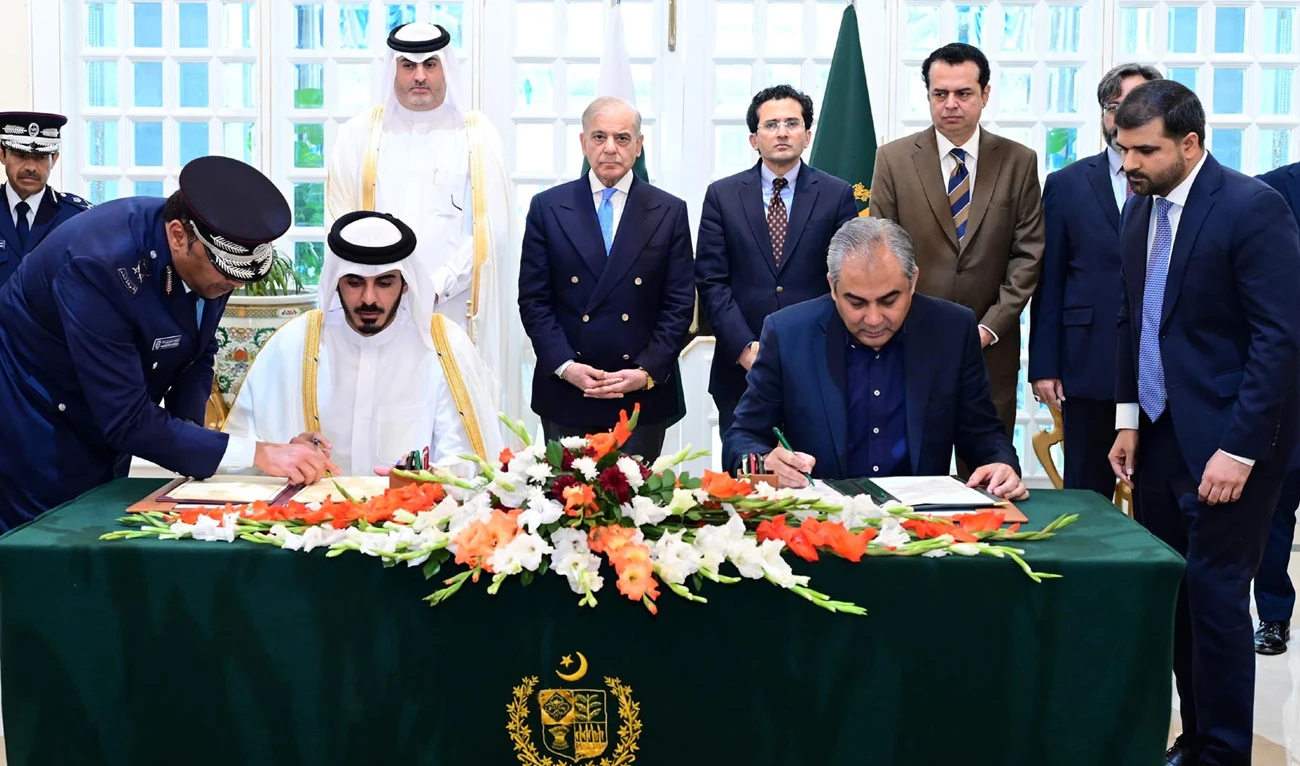
“The Prime Minister also witnessed the signing of a Memorandum of Understanding (MoU) on Security Cooperation between the Internal Security Force (Lekhwiya) of Qatar and the Federal Constabulary of Pakistan, as well as an Action Plan on the Fight Against Drugs,” Prime Minister Shehbaz Sharif’s office said in a statement after he met Qatar’s Interior Minister Sheikh Khalifa bin Hamad bin Khalifa Al Thani, who commands Lekhwiya.
The signing follows talks between the Qatari minister and his Pakistani counterpart Mohsin Naqvi in Doha in October, when they agreed to expand cooperation on internal security. Their discussions also covered regional peace and stability.
Sharif thanked Qatar during Thursday’s meeting for continuing to supply Pakistan with liquefied natural gas. The relationship has particular weight during the war: the disruption around the Strait of Hormuz has threatened a route that carried roughly a fifth of the world’s traded oil and LNG before the conflict.
Sharif also said about 300,000 Pakistanis worked in Qatar and called for greater cooperation on trade and investment, agriculture, technology and minerals, according to his office.