- Eight foreign ministers discuss Hormuz crisis, urge restraint amid fears of renewed US-Iran hostilities
- R4 ministers strongly condemn Houthi attacks on Saudi Arabia, commercial shipping in the Red Sea
ISLAMABAD: Pakistan and Saudi Arabia on Friday reaffirmed their defense partnership and commitment to regional security as foreign ministers from eight Middle Eastern and European countries met in Istanbul to seek diplomatic solutions to the Iran conflict and escalating Houthi attacks on the Kingdom.
The talks came amid fears of renewed US-Iran hostilities and mounting threats to regional shipping routes, particularly the Strait of Hormuz. Pakistan, which has sought to mediate between Washington and Tehran, is also bound by defense agreements with Saudi Arabia, whose energy and civilian infrastructure have come under repeated Houthi attacks.
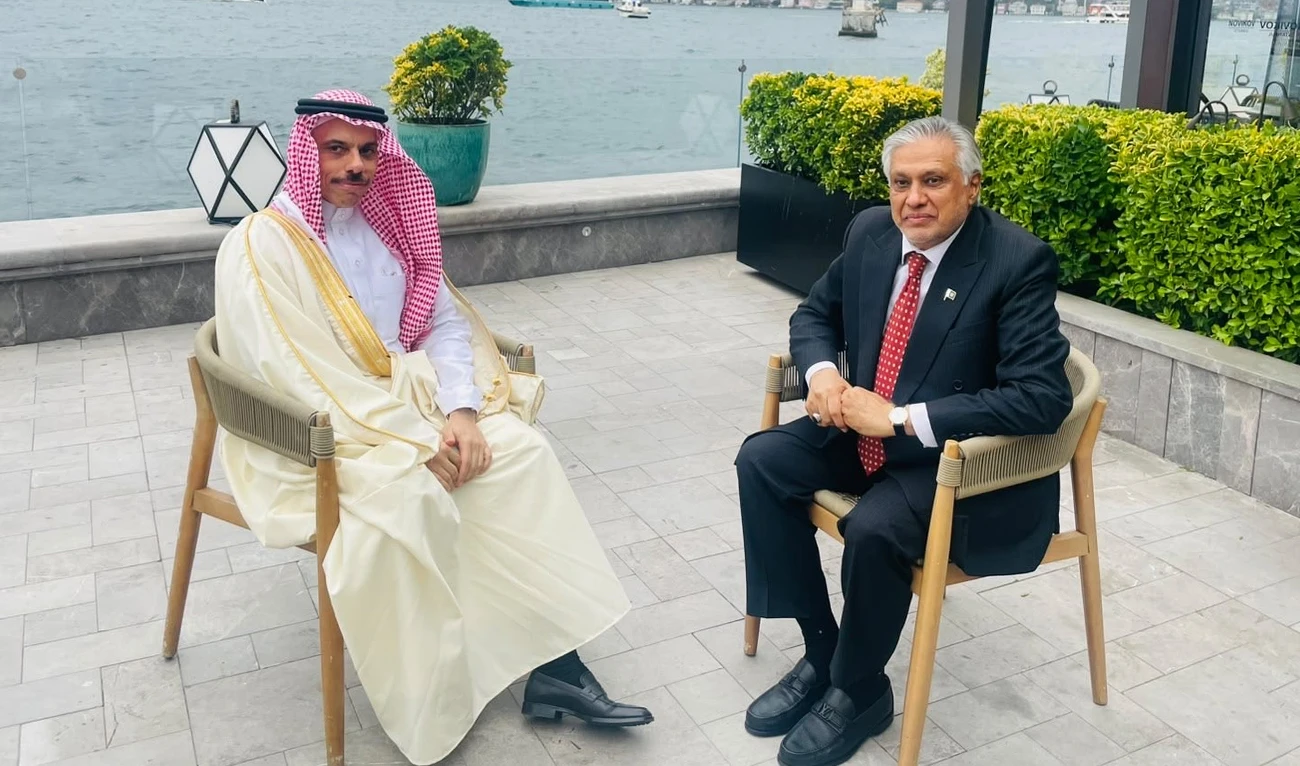
Pakistan’s Deputy Prime Minister and Foreign Minister Ishaq Dar met his Saudi counterpart, Prince Faisal bin Farhan, on the sidelines of the Regional Four (R4) meeting, which brought together Pakistan, Saudi Arabia, Türkiye and Egypt.
“Both leaders underscored the special bond between the two countries, reinforced by the Strategic Mutual Defense Agreement and the Makkah Defense Alliance, and their shared commitment to regional peace, security and stability,” Pakistan’s Foreign Office said in a post on X.
Dar reaffirmed Islamabad’s full support for Saudi Arabia’s sovereignty and territorial integrity, while both sides pledged to strengthen their strategic partnership through regular consultations and closer cooperation.
Pakistan and Saudi Arabia have longstanding military ties, strengthened by a bilateral defense agreement signed last year and the Makkah pact established with Türkiye in August. The latter provides for collective defense in the event of an external armed attack on any of the three countries.
The defense arrangements have gained renewed significance as Yemen’s Iran-aligned Houthis have intensified attacks on Saudi Arabia. The strikes have disrupted aviation and threatened energy infrastructure, prompting Britain and France to announce military assistance to help protect the Kingdom.
Separately, the foreign ministers of Pakistan, Saudi Arabia, Türkiye and Egypt issued a joint statement following their R4 meeting, calling for a diplomatic resolution of the US-Israel conflict with Iran and endorsing the Islamabad Memorandum of Understanding.
The ministers also called for the swift reopening of the Strait of Hormuz, warning that disruptions to maritime trade threatened global energy, fertilizer and food supplies.
They described the Israeli occupation as “the fundamental source of instability in the region and beyond,” condemned settlement activities and reiterated support for an independent Palestinian state and uninterrupted humanitarian assistance to Gaza.
“Regarding Yemen, the Ministers condemned in the strongest terms the unacceptable escalation by the Houthi militia, which has deepened humanitarian suffering, as well as the continued strikes carried out by the Houthi militia against the Kingdom of Saudi Arabia, particularly those targeting civilians and civilian infrastructure, and the attacks carried out against commercial shipping in the Red Sea and the Bab Al Mandab,” the statement said.
At a separate meeting involving the four regional countries and foreign ministers from France, Germany, Italy and Britain, discussions focused on the Strait of Hormuz, the conflict in Yemen, the Palestinian issue and other regional crises, with European ministers warning that renewed military confrontation with Iran could further destabilize the region and disrupt global energy supplies.
French Foreign Minister Jean-Noel Barrot warned that another escalation between Washington and Tehran would have serious consequences for oil and gas prices.
“And so the first thing this group of eight countries ... will do is call on both sides to exercise the utmost restraint, because we cannot afford another escalation in the region,” he told reporters on the sidelines of the meeting, according to AFP.
Italian Foreign Minister Antonio Tajani also urged a diplomatic solution to the Strait of Hormuz crisis, saying military action alone could not restore freedom of navigation through the vital waterway.
“I do not believe the problem can be solved from a purely military standpoint,” he said.
Turkish Foreign Minister Hakan Fidan, who hosted the gathering, stressed the importance of regional countries taking responsibility for their own security and strengthening cooperation to address common threats.
The Strait of Hormuz, a crucial route for global oil shipments, has faced severe disruptions during the US-Iran conflict, raising concerns about energy prices and international trade.
Pakistan’s Foreign Office said Dar briefed the participating ministers on Islamabad’s continuing diplomatic and mediation efforts aimed at easing tensions, preventing renewed hostilities and promoting peace.
The ministers agreed to continue consultations in the eight-country format, reflecting efforts to establish a broader diplomatic mechanism involving regional and European powers.
Dar also held separate meetings with German Foreign Minister Johann Wadephul and Egyptian Foreign Minister Badr Abdelatty, discussing bilateral cooperation and regional developments, including the situation in Palestine.
With inputs from AFP.